
-
Martingale dog collar greyhound
Regular price $28.00 USDRegular priceUnit price per$35.00 USDSale price $28.00 USDSale
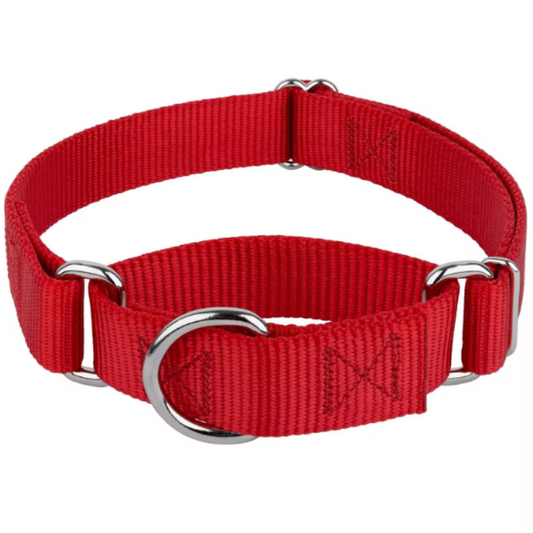
Martingale dog collars can look a little odd if you have only ever used a normal buckle collar.
Instead of one fixed band, there are two sections. The larger loop sits around the neck and a smaller loop is connected to it. The lead normally attaches to that smaller section.
Once you have seen one in your hands, the design makes much more sense than it does in a photograph.
How the Two Loops Work
The smaller loop is the part that moves when there is tension on the lead.
As that section is pulled, the main part of the collar becomes smaller around the neck. When the tension comes away, it loosens again.
That is where the name “half choke collar” comes from, although a martingale is constructed differently from a full slip collar. The smaller section limits how far the main loop can close, depending on how the particular collar has been adjusted and made.
It is worth looking closely at the product photographs here. They normally show the two sections much more clearly than the main collection picture.
Don't Buy One Just to Stop Pulling
The collar itself does not teach a dog how to walk on a lead.
If a dog pulls, the moving section of the collar will react to that tension. That is simply how the design works.
Training is a separate matter.
It is better to choose the collar because you understand how the martingale mechanism works and want that style of collar, rather than expecting it to change a dog's walking habits on its own.
The Fit Needs a Little More Attention
With an ordinary fixed collar, you are mainly looking at the neck measurement and the adjustment range.
A martingale has the extra moving section to think about as well.
Check the sizing information on the individual product page before ordering. Don't choose purely because your dog is described as small, medium or large.
Once fitted, the moving loop should work in the way shown in the product instructions.
If you are unsure how far a particular martingale should close, use the fitting guidance supplied with that collar rather than guessing.
Look at the Smaller Loop
When comparing two martingale collars, most people naturally look at the colour or the main band first.
Have a look at the smaller loop as well.
Its size, position and the way it joins the rest of the collar are a big part of how the whole thing is constructed. The lead attachment will normally be around this area too.
The side photographs are often particularly useful because you can see how much extra material and hardware sits away from the dog's neck.
Some designs look fairly compact. Others have a more obvious second section.
Martingale or Slip Collar?
The two styles are easy to confuse from a quick photograph.
A slip collar normally forms one moving loop. A martingale uses a larger neck loop plus a smaller control loop.
That extra section is the easiest way to tell them apart.
If you are specifically looking for a martingale dog collar. Check the product description rather than relying on the shape in the first photograph.
Check the Collar From Time to Time
The moving parts are worth having a quick look at now and again.
Check where the smaller loop joins the main collar and look over any rings, stitching or other joining points shown on your particular design.
If anything has started to come apart, stop using it and replace it rather than carrying on because the rest of the collar still looks fine.
Is a Martingale the Type You Want?
The main reason to choose one is its two-loop construction.
If you prefer a collar that stays at one adjusted size and opens with a buckle or clip, another style may make more sense.
If you specifically want the martingale arrangement, compare the available designs by size, width and how the smaller loop is put together.
That will tell you far more than broad claims about control or training.
Read the individual listing before ordering, particularly the measurements and fitting information. Once you understand the two-loop design, choosing between the collars becomes much more straightforward.